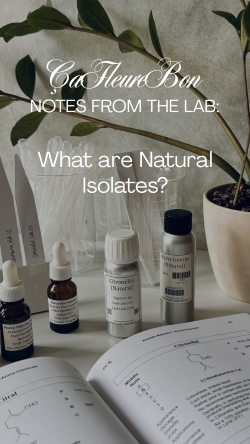

Natural Isolates Mouillettes photo by Whitney of Wit & West
When I first started my journey into the world of perfumery, I was excited and a bit overwhelmed by the number of different ingredients at my disposal. Today’s perfumer has access to thousands of different aroma molecules which can either replicate those found in nature or exist entirely outside the natural world. There are also over 500 materials that can be processed through various methods to produce ingredients derived from nature.
As a perfumer focused on materials of natural origin, I love working with naturals that retain the entire soul of a botanical, while being open to different tools and techniques to enhance their beauty. One of the ways that I do this is by using multiple extractions of the same botanical in a perfume formula; for example, distilled rose essential oil, solvent extracted rose absolute, and rose CO2 obtained via CO2 extraction. In addition to the commercially available natural perfumery ingredients, I also use my own in-house extractions including tinctures and enfleurage extraits.

Vanilla beans for vanilla tincture photo by Whitney of Wit & West
But these common extraction methods are not the only way that natural materials can be transformed into useful perfumery ingredients. There are also ingredients created via methods that you may be less familiar with, including fractional distillation and fermentation. These methods can be used to create ingredients known as natural isolates. While you’ve probably heard of them, you might wonder what their purpose is, where they come from, and why they are used in perfumery.

Erlenmeyer flasks with plant stems photo by Whitney of Wit & West
Natural isolates are defined as single aromatic molecules that are derived, or “isolated,” from natural raw materials. Some common examples of natural isolates include linalool (green, woody, and floral, lavender-like molecule found in many plants, flowers, and herbs), phenyl ethyl alcohol (honeyed tea rose-like aroma molecule found in roses), vanillin (sweet and vanilla-like molecule found in vanilla beans and cloves), and coumarin (sweet, hay-like molecule found in tonka beans).

Natural isolates from the Wit & West studio photo © by Whitney Swales
Natural isolates can be obtained via various separation techniques, including fractional distillation, or produced through fermentation and other biotechnology processes using natural materials such as plants, flowers, resins, yeasts, fungi, and other botanical materials.
Fractional distillation is a process that isolates a substance such as an essential oil into its component parts, or fractions, through distillation. Using a special vertical tube known as a fractionating column that is placed between the distilling flask and three-way adapter, the process further facilitates isolation by heating an essential oil to a temperature at which one or more of its fractions vaporize, allowing the various isolates to be collected in liquid form.
Depending on the material and specific equipment, the resulting fractions may be a mixture of many compounds, such as in the case of patchouli fractions or ylang-ylang fractions, or they may be individual aroma molecules, such as in the case of geraniol obtained from palmarosa.

Fractional distillation (Source: Wikipedia)
In the process known as microbial fermentation, living microorganisms break down organic substances, like sugars, into simpler products. One example of fermentation that we are all familiar with to some degree is winemaking, in which yeasts transform sugars in grape juice into ethanol and carbon dioxide. The resulting wine is then clarified or filtered and bottled.

Vineyard in the coastal town of Raglan on New Zealand’s North Island photo © by Whitney Swales
The creation of natural isolates using fermentation works in a similar way, although the goal and resulting product is different. Instead of the final product being a fermented liquid that is kept in its entirety, as in the case of wine, the fermentation process is designed to isolate a specific aromatic compound. For example, the naturally occurring molecule in vanilla, known as vanillin, can be produced via microbial fermentation by introducing a plant compound such as ferulic acid (found in rice bran or corn hulls) to microorganisms such as bacteria, yeast, or fungi. The microorganisms convert the ferulic acid into vanillin through a series of biochemical reactions. From there, the microorganism is removed through purification processes such as filtration or similar processes, leaving the resulting product, natural vanillin.
Over the last several decades, the use of fractional distillation and biotechnology processes such as microbial fermentation has grown in response to increasing demand in the flavor and fragrance industries. Growing demand for natural ingredients, along with increased ingredient costs, sustainability concerns, supply constraints, weather, and geopolitical factors, have all contributed to the industry’s push for alternative ways to produce these ingredients.
You might have heard that using only naturals in perfumery has limitations. This is true to an extent, as many synthetic aroma molecules simply do not exist in nature. And in some cases where they do exist in nature, there are other issues that arise such as sustainable and ethical ingredient sourcing. However, I believe challenges in perfumery can also inspire creative solutions. Natural isolates provide perfumers with an expanded palette of natural perfumery ingredients, while also allowing for greater control over the individual components of a formula, which can help manage allergen exposure and regulatory restrictions.
As an example, a perfumer who is looking to enhance natural rose materials such as rose absolute and distilled rose oil (also known as rose otto), may choose to incorporate some of the basic key components of a rose accord into their formula using natural isolates such as phenyl ethyl alcohol, citronellol, and geraniol. By using these natural isolates as a starting point for an accord, the perfumer can not only create something unique to them, but they can also manage allergen risk and regulatory restrictions more easily.

(Rosa Damascena) hand painted by Mandy Aftel of Aftelier Perfumes from antique botanical woodcuts. (used with permission for this article)
Not only are natural isolates useful for reconstructing or enhancing standard accords such as the rose accord, but they can also give perfumers the ability to create entirely new olfactory effects. I first became interested in both the practical and creative potential of natural isolates while learning about them as a part of the Slow Scent® Natural Perfume Class taught by renowned natural perfumer Mandy Aftel of Aftelier Perfumes. In the class, I discovered that Mandy composed her perfume, Memento Mori, primarily using natural isolates. (Read former Natural Perfumery Editor Einsof’s 2016 review here).

Patchouli (Pogostemon cablin) hand painted by Mandy Aftel from antique botanical woodcuts.(used with permission for this article)
We asked Mandy to share a bit more about the story behind this perfume and how she chose specific natural isolates for inclusion in the perfume formula. Mandy told us:
“Memento Mori is a perfume about grieving, and I wanted it to smell like a person’s skin that you had been close to. The texture and single aromas of the natural isolates I used were crucial to being able to bring my vision to life, since they blend seamlessly with the other essential oils and absolutes. I used beta ionone which combines the sorrowful violet with forest floor aromas. I chose the lightest patchoulis, patchoulyl acetate, along with the tea rose aroma of phenyl ethyl alcohol to make the rose absolute more transparent. But most important to the perfume was the animalic note of phenylacetic acid which expressed the sense of human skin when it blended with butter CO2.”
Like Mandy’s creative solution for evoking the smell of the skin of a loved one, creating the effect of musk is another puzzle in natural perfumery. Historically, this was typically done using animal-derived ingredients such as civet, a glandular secretion obtained from the weasel-like animal of the same name, and others such as castoreum, an exudate obtained from the North American beaver. Though these ingredients can still be sourced from select suppliers, their use has become less common as concerns around animal welfare and sustainability have grown. And while there is an array of synthetic musk options available to the perfumer, if you are focused exclusively on naturals, there are very few options available.

Wit & West Streetcar Magnolia photo© by Whitney Swales
One way I have learned to solve this for my own brand, Wit & West, is by using the natural isolation of the musk known as ambrettolide (which can be fractionated from ambrette seed or produced via microbial fermentation), along with other botanical musk ingredients including ambrette seed and angelica root (both of which include naturally occurring musk molecules), and naturals that either enhance musk ingredients or have a musk-like quality such as patchouli, some species of sandalwood, and others. I use a combination of these natural isolates along with other natural musk-like botanical ingredients in Streetcar Magnolia, from the Cologne Collection, and Caldera Flower, a perfume from the Reserve Collection.

Wit & West Jasmine Pet Noi photo by Whitney
Natural isolates can also help perfumers manage ingredient inventory and supply issues commonly associated with whole botanicals. Another example from my brand Wit & West is vanilla absolute and vanilla CO2. Natural vanilla is primarily cultivated in Madagascar and other tropical regions, including Indonesia. Unfortunately, these regions are often subject to weather-related impacts that can affect availability and price. By using a vanillin natural isolate in addition to vanilla absolute and vanilla CO2 (along with other vanillic and balsamic ingredients such as benzoin), I can create unique vanilla and gourmand accords that wouldn’t be possible using essential oils, absolutes, and CO2 extracts alone. I use a vanillin natural isolate along with other extractions of vanilla and vanilla-like ingredients in Jasmine Pet Noi, a spicy amber-floral perfume from the Signature Collection, and La Valse, a rose-centric gourmand perfume from the Reserve Collection.
As an artisan natural perfumer, I am encouraged and excited to see the growing number of natural isolates available for use in perfumery. They not only expand what is possible creatively but also give perfumers additional tools for navigating the challenges of working with natural ingredients.
–Whitney Swales, Contributor and natural perfumer for Wit & West

Wit & West Perfumes Customizable Sample Set
Thanks to the generosity of Wit & West, one registered reader in the USA will receive a Customizable Sample Set with 5 (five) 1.5ml samples that feature natural isolates including: Caldera Flower, Jasmine Pet Noi, Streetcar Magnolia, La Valse, and Yuzu Pop, plus, a $50 digital gift card to use toward a future purchase. Please register here or your comment will not count. To be entered, in the comments section below, share what you learned and what you found interesting about natural isolates discussed in the article, why, and that you live in the USA. Draw closes 10/10/2026
Whitney Swales is the perfumer and co-founder along with her husband Rob for Wit & West Perfumes. Read Whitney’s Profile in American Perfumery here. Wit & West’s Violetear was Sandi’s Best Of in 2023. Michelyn named Wit & West Caldera Flower Best Natural Perfume 2025, and both Sandi and Michelyn’s Top 10 Perfumes in 2025. Read Whitney’s Notes From The Lab: Slow Perfumery here Whitney was featured in Next Gen: Natural Perfumers here
Michelyn’s interview with Mandy Aftel here
Please Like our Facebook page Notes From the Lab and your comment will count twice
Follow us on Instagram @Cafleurebonofficial @witandwest @AftelierPerfumes
This is our Privacy Policy
We announce the winners only on our site and our Facebook page, so like ÇaFleureBon, use our blog feed, or your dream prize will be spilled perfume.
Like our Facebook Page CaFleureBon and use our blog feed for new updates and articles.
Trending Products


YouKD Summer Long Kaftan Bohemian Beach Kimono Swimsuit Cover Up Plus Size Dress for Women