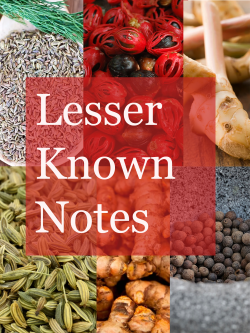

Collage of Lesser-Known Spices by J Wearescentient
There is such a plentiful assortment of spices that are featured in perfumery, many for which we are quite familiar. Think black pepper, cinnamon, clove, cardamom, nutmeg, anise, coriander, and so forth. We can encounter, however, certain spices that are not as familiar to the palate or to the nose. In this third and final installment of the series, we explore eight of these less common and even arcane spices that provide distinct accents to fine fragrance.

Lesser-Known Spices Notes- Asafoetida free use
Asafoetida: Perhaps the most fascinating—and pungent—in this line up is Asafoetida (Ferula assa-foetida). A relative of other umbellifers such as carrot and galbanum, this fabled plant, also known as hing, has eyebrow-raising nicknames such as stinking gum and devil’s dung. The gum oleoresin extracted from the rhizomes of the plant is notoriously odoriferous, and if smelled in isolation may be a shock to those expecting something more pleasant for a botanic ingredient used in cuisine and perfumery. It is however, a beloved flavoring used in Indian and Middle Eastern cuisines for its alliaceous odor, similar to onion and garlic, due to the presence of organosulfur compounds. In the West, it has been used a secret ingredient in Worcestershire sauce. This resin has long found use in perfumery as a fixative, like its cousin galbanum. Also, it can boost the effects of its cousin, with minute amounts of this high-impact material having a transformative effect in compositions. It can bring out sharply vegetal and bitter-green facets of florals, leather, and even amber.

Grès Cabochard, Balmain Vent Vert Ivoire de Balmain- photos by Joseph Colbourne
Asafoetida appears in some classic chypres such as the iconic Grès Cabochard, composed by Bernard Chant, giving articulation at the top to its florals, leather, and tobacco. Ma Griffe from Carven can attribute its feisty verve to the appearance of Asafoetida alongside styrallyl acetate, a dry, intense, green floral aromachem often used to build a gardenia accord, which appears in Ma Griffe’s heart. Both Balmain Vent Vert and Ivoire de Balmain feature Asafoetida, with the former’s use apparently enhancing the galbanum in Germaine Cellier’s legendary composition, and in the latter as an enhancer for its sharp yet luminous floral accords.

Lesser-Known Spices Notes- Turmeric rhizome photo – free use
Turmeric: We may very well be aware of turmeric (Curcuma longa) through its use as a key ingredient in Asian and Middle Eastern dishes and in curries. Its rhizome powder also imparts a radiant yellow color to foods among other items and has been long valued in Ayurvedic medicine for its healing properties. In the west, it has gained popular over the counter as a supplement to aid in inflammation, though there is little scientific evidence to support this claim. A part of the ginger family, Zingiberaceae, its use in perfumery lends a certain mystique to compositions. Earthy, warm, somewhat bitter and reminiscent to vetiver, black pepper and even mustard, Turmeric has shown up in a number of releases in recent years, with perfumers employing it as a means of modifying florals, ambers, woods, and leather.

Vaporocindro for January Scent Project. Godet Parfums Calme & Volupté Bangla Yasaman from Isabelle Larignon photos by Joseph Colbourne
Perfumer John Biebel uses turmeric in his release. In this fascinating composition, we find curcuma in full-effect, somehow illuminating the lilac and narcissus accords found within, while underlining its earthy facets overall. In Godet Parfums Calme & Volupté, turmeric draws out the rustic, almost musty quality of lavender that I love so much. This synergy between the two reminds me of how the lavender buds smell when still attached to the plant, in the field, under the sun. Bangla Yasaman from Isabelle Larignon has turmeric lending a bright, dry, almost dusty element to the top notes of this grand jasmine perfume.

Lesser-Known Spices Notes Caraway seed photo – free use
Caraway: I love caraway. They are tasty on buns, baked into rye bread Irish soda bread, British seed cakes; the best everything bagels include caraway. The seeds of the Carum carvi plant, caraway yields an essential oil that is traditionally used in aromatherapy and also perfumery. It’s aroma is delightfully pungent, anise earthy, almost savory, with just a bit of sweet spiciness, courtesy of the constituents carvone, limonene, and anethole. In perfumery, enthusiasts seem to often confuse it with cumin. While both are umbellifers belonging to the carrot family, with seeds that look similar to each other, the two do differ in scent profile. While cumin has a more pronounced pungency that may evoke perspiration and even subtle body odor, caraway rather only suggests bodily warmth. The two do get along quite famously and both appear together in perfumes to draw out a certain sensuous element to spicy accords.

Azzaro Pour Homme, Diptyque L’Autre, Arabie from Serge Lutens photos by Joseph Colbourne
In the classic Azzaro Pour Homme from 1978, the caraway is prominent, particularly in older formulations, imparting that sensuous warmth to contrast with the aromatics of lavender, clary sage, and star anise. Diptyque’s seminal release L’Autre, we find an example of caraway paired with cumin for that corporeal effect among coriander, nutmeg, and pepper. The absolutely sensational Arabie from Serge Lutens, a veritable spice bazaar, features caraway among other spices, dried fruits and dates.

Lesser-Known Spices Notes Fennel seed photo – free use
Fennel: Yet another umbellifer in the carrot family (Foeniculum vulgare) on this list, my first encounter with fennel seeds was while visiting an Indian restaurant, having discovered they were offered to cleanse the palate after a meal, plain and candy-coated. I noted that the flavor was similar to licorice and anise, but with some aspects of sassafras and mint. Some may be familiar with fennel fruits for their use in Italian sausage and the bulb, foliage, and leaves appear in all manner of cuisine. Its appearance in fine fragrance, while infrequent, is no less a delight, imparting fresh, herbal, earthy and anisic qualities to compositions.

Oriza L. Legrand Chypre Mousse, Miller et Bertaux 23/Newsletter and Nissaba Les Alpes photos by Joseph Colbourne
The beguiling Chypre Mousse from Oriza L. Legrand features fennel lending its earthy sweetness to the angelica, moss and overall agrestic nature of the composition. Study No. 23/Newsletter from Miller et Bertaux is a dry, effervescent incense scent that prominently features fennel alongside olibanum, myrrh, immortelle, and cedar. Les Alpes is a brilliant release from Nissaba where bitter fennel oil (Foeniculum vulgare Mill. var. amara) from Spain lends a grassy, woody, mildly sweet character alongside hay and pine, and a panoply of aromatics.

Lesser-Known Spices Notes Dill weed and seed photo – free use
Dill: Is it the weed or the seed? Is it an herb or a spice? I took the liberty of including dill (Anethum graveolens) here, regardless of its classification, as it both herbal and spicy, whether the leaves or fruit are used. It is the fourth umbellifer in the Apiaceae family on this list and much like its cousins, there is anise-like facet to it. There is much more to dill however; it is grassy, warm, crisp, somewhat sweet, with some similarities to the aforementioned caraway. A staple of both Mediterranean and Scandinavian cuisine and famously used to season pickles and gravlax, dill in perfume may come as a surprise to many. However, its distinct character can serve as a bridge between green and spice notes.

WA:IT EN and Lorenzo Villoresi Piper Nigrum photos by Joseph Colbourne
WA:IT EN is a brilliant release from 2026 that showcases dill and a compelling interplay between it and a generous dose of olibanum resin. While Lorenzo Villoresi Piper Nigrum is an ode to black pepper, dill is among a number of aromatics that flesh out and animate the peppery freshness of the composition.

Lesser-Known Spices Notes Galangal root photo – free use
Galangal: A member of the Zingiberaceae family like turmeric and ginger, galangal (Alpinia galanga) finds much culinary use in its South and Southeast Asia. You haven’t lived until you tried Cambodian (Khmer) cuisine, with frequently features galangal, most notably so in kroeung, and paste consisting of herbs and spices that serves a base in many of its dishes. Decidedly more floral and camphoraceous that its cousin ginger, it also possesses facets of black pepper, cinnamon, even pine and melon. The fragrance profile does vary depending on the terroir and chemotypes. For example, Sumatran galangal leans spicier and more earthy, while Javanese galangal is warmer and sweeter. Cambodian galangal is quite spicy, sweet, warm, and woody. In perfumery, it lends an exotic, earthy, almost medicinal spiciness that gives lift and adds interest to amber and woody compositions.

Opium Pour Homme, Carner Barcelona Sweet William, January Scent Project Gong photos by Joseph Colbourne
Perhaps the most well-known fragrance that happens to feature a galangal note is that of the recently discontinued Opium Pour Homme from YSL; here, the galangal lends a coolly piquant quality among anise, blackcurrant, and balsams. Rodrigo Flores-Roux’s contribution to Carner Barcelona, Sweet William, is an ode to dianthus that is lifted by galangal in its opening, enhancing its delicate floral profile. January Scent Project makes a second appearance on this list with Gong, where John Biebel includes galangal as a warm complement to the green, vegetal, and fruity elements that swirl around in this unique composition.

Lesser-Known Spices Notes Mace photo – free use
Mace: Now Mace (Myristica fragrans) is an unusual entry here, as it a distinct spice coming from the same plant as nutmeg. However, while nutmeg derives from the seed, mace is the lacy, crimson aril that surrounds the seed. When dried, its color is a golden-brown to tan, and is most often ground into a powder, much like its sibling spice. Whole mace is often used much like bay leaf for long simmers in certain dishes, and it finds versatile use in both savory and sweet preparations. What makes the aromatic profile different is that mace is sharper, with vibrant, zesty qualities similar to citrus, pine and black pepper. One smart comparison between mace and nutmeg is to consider the difference as similar to that of the peel of an orange to its flesh. Mace is not common in perfumery, but its use is certainly worthy of consideration, especially considering the essential oil of mace is available to the perfumer’s palette.

Marescialla from Santa Maria Novella. Eris Parfums Mxxx., Lalique Pour Homme Equus photos by Joseph Colbourne
In the bewitching Marescialla from Santa Maria Novella, composed in 1828, mace is paired with citruses as they pierce through the senses; the sharp aroma of the mace sets the tone for this old-world marvel of camphor, astringency, floor wax and old wood. Antoine Lie incorporates mace in his Mxxx. for Eris Parfums, accentuating the tawny, dusky cacao in its heart and the saline sparkle of ambergris tincture. A favorite woody fragrance of mine, Lalique Pour Homme Equus, sees the bright, punchy mace among other aromatics such as cardamom and juniper, animating the redwood forest accord at its core.

Lesser-Known Spices Notes Allspice photo – free use
Allspice (Pimento): Lastly, whether allspice (Pimenta dioica) is necessarily a “lesser known” spice may be up for debate, especially for those familiar with it being a key ingredient in a classic bay rum cologne (along with West Indian Bay). It does, however, make few appearances in fine perfumery and when it does, it seems to be for strategic effect. Contrary to popular belief, it is not merely a mixture of all sorts of spices. Rather, the dried, unripe berries of the plant, also known as pimento berries, are used for their dynamic profile that shares the characteristics of clove, nutmeg, cinnamon, and black pepper. Widely used in the cuisine of the West Indies (Jamaican jerk season), Middle East, and Europe (Brown sauce and Karelian hot pot). It is a key ingredient in traditional English Christmas pudding.

Miller Harris Feuilles de Tabac, Trudon Mortel and Ulrich Lang New York Apsu – photos by Joseph Colbourne
In the classic composition from Miller Harris Feuilles de Tabac, Lyn Harris uses allspice to enhance the dry, warm tobacco accord. Mortel, from Trudon, is a inviting hearth-like incense where perfumer Yann Vasnier incorporates allspice that massages into the olibanum resin, moving it away from austere and toward a retiring warmth. Apsu from Ulrich Lang New York features the noble pimento berry as it imparts and necessary spicy contrast in this ultra-green, leafy, watery composition.
There are still other lesser-known spices that have made appearances in perfume, such as ajwain, fenugreek, sumac, tamarind, cubeb pepper, white pepper. Might there be any others you’d like to share? Let us know in the comments.
Disclosure: From my own collection
Joseph Colbourne, Guest Contributor
This concludes the Lesser Known Notes Series: Read about Flowers and Herbs
Special acknowledgement to J Wearescentient @wearescentient for his assistance in collages and the reel-MIchelyn
Follow us on Instagram @cafleurebonofficial @jjcolbourne
This is our Privacy Policy
Trending Products


YouKD Summer Long Kaftan Bohemian Beach Kimono Swimsuit Cover Up Plus Size Dress for Women