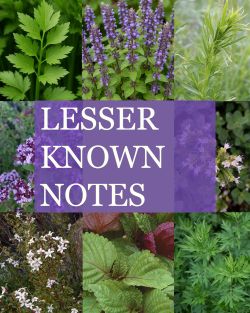

Collage of Lesser Known Herbs used in perfumery by J @wearescentient
When we think of herbaceous and herbs in perfumes, what most often comes to mind is rosemary, basil, thyme, mint, sage, clary sage, even plants in the artemisia family like mugwort or wormwood. There are, however unless they may have some culinary acumen or are intimately familiar through raising an herb garden. In this installment, we profile eight herbs that are employed in perfumery but seldom are given fanfare.

Lovage plant photo – free use
Lovage: Lovage (Levisticum officinale) is one of my personal favorite herbs. Native to Iran and Afghanistan, it was brought to Europe to be cultivated for its leaves as an herb, root as a vegetable, and seeds as a spice. In fact, the seeds were used in medieval times as an ingredient in a love potion. It’s an umbellifer, sharing a family with carrot, parsley, celery, and angelica. In fact, the aroma of its leaves and stems are reminiscent of spicy celery and parsley, and the root has a similar scent to that of angelica root, with hints of licorice. One leaflet chopped up and added to salads and soups can add such flavor and character (they have an affinity for potatoes). The strong aromatic quality and savory depth of lovage makes it rather useful in perfume. Though both lovage leaf and lovage root oils are used, it is most frequently used as an accent that modifies other notes in a composition. The root of the oil is in fact one of the most powerful naturals, and its use even in traces makes a noticeable impact.

The Different Company Sel de Vetiver and In Dead Air for Oddity Fragrances.
Lovage seldom appears as part of the notes pyramid in spite of its appearance in formulae, but there are occasions where it has been highlighted. Take for example Sel de Vetiver, from The Different Company. Perfumer Céline Ellena’s addition of lovage leaf imparts a savory, vivacious character to the composition, animating the salty impression and flattering the raw beauty of the vetiver at its core. In fact, I would argue that it is in fact the star player here. In Dead Air, Mark Buxton’s composition for Hong Kong-based Oddity, the appearance of the licorice-fennel-celeriac scented lovage root creates a fascinating contrast with the woody, spicy, fruity elements therein, adding to the wonderfully peculiar atmosphere of the fragrance.

Hyssop free use
Hyssop: Many of us may have had our first encounter with the word “hyssop” through the bible (“Purge me with hyssop, and I shall be clean”) but that reference is believed to pertain to a different plant altogether, Origanum syriacum, or Syrian oregano, the “biblical hyssop.” Hyssopus officinalis is the true hyssop, a stimulating, tannic aromatic herb high in thujone, phenol, and cineole. Its fragrance could be described as a combination of coniferous needles, rosemary, wormwood, mint, and sweet camphor, with hay-like and tea-like facets in its dry down. In fact, the leaves and the flowers are quite fragrant. It’s known for its use in chartreuse and absinthe; my experience with the oil revealed immediate recognition from these libations. Also long used in traditional herbal medicine and as part of Middle Eastern cuisine through its use in the herb blend Za’atar, Hyssop shows such versatility in use. Therefore, it comes as no surprise that it finds use in perfume as well. A potent oil is distilled from hyssop, so very little can make an impact in a composition, proving effective in woody aromatic compositions and a ‘secret ingredient’ in fougères.

Nissaba Provence, Hermès Equipage and Caron Yatagan photos by Joseph Colbourne
Provence, the 2024 release from the Swiss house Nissaba, sees Hyssop taking center stage, supported by lavender, clary sage and coriander, to evoke the Mediterranean garrigue. Hyssop is featured in two classics: Hermès Equipage from 1970 and Caron Yatagan from 1978. In each, hyssop imparts dynamism and naturalism to their complex profiles, proving its value in perfumery as a behind-the-scenes elevator for compositions.

Oregano plant photo – free use
Oregano: Now many will immediately associate oregano as a staple for Italian and other Mediterranean cuisine, a favorite seasoning for pizza, and as an antiviral/antimicrobial in alternative medicine. There is something to be said, however, for how uniquely aromatic Origanum vulgare really is: the high quantity of phenolic compounds (cavracrol, thymol) lending a pungent, warm, almost medicinal quality to its essential oil. It can conjure up images of sun-dried herbs covering the banks of the maquis shrubland. Though oregano does not appear frequently in perfumery, there are notable instances where it’s included to enhance existing accords or to lend an authentic herbaceous sensation.

Lorenzo Villoresi Spezie, Serge Lutens Ambre Sultan and Amouage Interlude Man photos by Joseph Colbourne
Lorenzo Villoresi Spezie is an impressive medley of spices and herbs, but it is oregano in particular that really peeks through in its development, giving it so much character and vitality. In Christopher Sheldrake’s seminal Serge Lutens Ambre Sultan, it is oregano that pulls that, along with bay leaf, pulls the amber accord in a satisfyingly savory, dry-herbal direction. Amouage Interlude Man is notorious for the punchy oregano that dominates its top notes.

Marjoram plant – free use
Marjoram: It makes perfect sense to follow Oregano with one of its close cousins, Marjoram (Origanum majorana), both are culinary herbs that on occasion sees its way until perfumes. Often referred to as Sweet Marjoram to distinguish it from a species of thyme often referred to as Wild Marjoram (Thymus mastichina L.), this plant surprisingly gives off more of a spicy aroma than one that is green-herbal. It is reminiscent of the warmest facets of nutmeg and cardamom, with softly sweet, woody undertones. It is recommended in perfumery for adding depth and richness to fougères, citrus aromatics and classic colognes. Fun fact: in ancient Greece, marjoram was used to make wreaths for wedding ceremonies and to decorate tombs.

Astier de Villate La Dieu Bleu, Jorum Studio Carduus, Marjolaine from Jean Couturier photos by Joseph Colbourne
In my last article for lesser-known floral notes, I mentioned Astier de Villate’s La Dieu Bleu, which contains a broom note. From the same Parfums Historiques series composed by Dominique Ropion, Artaban, prominently features sweet marjoram, leading the perfume with its delightfully spicy aroma, leading a panoply of other spices and resins. Carduus from Jorum Studio features marjoram contrasting with chamomile and other herbs, tea and honey for a riveting concoction. The discontinued and highly underrated Marjolaine from Jean Couturier is an ode to marjoram as a centerpiece to lucid florals like wisteria, lotus, and water lily.

Tarragon plant photo – free use
Tarragon: Here is another herb that may be much more familiar to cooks and epicureans than perfumer enthusiasts. Perhaps you may have enjoyed (or served) meals served with a béarnaise sauce of which tarragon is a main ingredient, or have had poultry, vegetables, or potatoes seasoned with tarragon. This herb, Artemisia dracunculus, also known as Estragon, is in fact in the same genus of plants as mugwort, wormwood, southernwood, sagebrush, and davana. The main constituent that gives it its distinctive aroma is estragole (comprising 60–75% of the essential oil), which is sweet, green, anisic, sassafras-like, fennel-like, herbal, phenolic, and somewhat minty. There have sadly been significant restrictions to estragole, but thankfully its potency allows it to make an impact even at very small doses. Tarragon oil has found use in chypres, fougères, and in various green floral bases.

Dryad from Papillon Artisan Perfumes, Lush’s Dirty Bottle, Chabaud Ile Mythique – photos by Joseph Colbourne
In Dryad from Papillon Artisan Perfumes, Liz Moores incorporates tarragon with great effect in a brilliant and beguiling green-woody chypre. Lush’s Dirty, while brimming with spearmint and herbs, is rendered dynamic and delicious through the addition of a prominent tarragon note. Patrice Revillard, the perfumer behind Chabaud’ Ile Mythique, creates an impressive anise accord, but the green-bittersweet tarragon that follows in its heart is arguably the true showstopper, especially as it mingles with dried fruits and myrrh into the dry down.

Shiso: Shiso (Perilla frutescens), also known as perilla, is commonplace in the cuisine of many East and Southeast Asian countries. A member of the mint family Lamiaceae, the aroma and flavor of shiso leaf could be described as a cross between basil, mint, clove, cinnamon, even caraway. It has seen recent use in perfume especially since the turn of the century, where a shift away from the Eurocentric has shown an increase in Eastern ingredients and accords. Its distinct character enlivens top notes and conveys a naturalism in aromatic and herbaceous fragrances.

Ys-Uzac Pohadka, Ume Floriography Eau Parfumée au The Bleu from Bvlgari – photos by Joseph Colbourne
Ys-Uzac Pohadka opens with a dazzling flourish of shiso that sets the tone for a grassy, agrestic beauty of a fragrance anchored with tobacco and immortelle—it happens to be one of my all-time favorites. Hong Kong-based Floriography presents shiso as part of an accord built around umeshiso, a condiment which blends umeboshi plum and red shiso leaf, and the result is sensational. In Eau Parfumée au The Bleu from Bvlgari, shiso is an intriguing accent juxtaposed with lavender and violet in this meditative tea scent.

Davana plant free use
Davana: Like Tarragon, davana is in the Artemisia family of plants. Yet the aroma of davana (Artemisia pallens) couldn’t be any different. As a matter of fact, while it is technically classified as an herb, this plant native to India has quite the scent profile. It is rather fruity, recalling blackcurrant, elderberry, ripe plum and apricot, with facets of dried fruit, liqueur, mulled wine, and tagete marigold, plus the slightest camphoraceous overtone. Therefore, it finds much use in perfumery for building accords pertaining to what its own scent profile resembles—dried fruits, dark berries, liquor, sweet florals. I absolutely love the essential oil of davana, and have been known to use it in an aromatherapy diffuser. There is something rather magical about such a complex scent profile coming from the leaves of a plant.

Bonne Chauffe from Frapin Bottle, Histoires de Parfums1740 Marquis de Sade, Dead Air from Oddity photos by Joseph Colbourne
Bonne Chauffe from Frapin is a lovely, boozy fragrance that evokes cognac, whiskey, and plum liqueur; therefore, it should come as no surprise that davana is used by perfumer Meabh McCurtin in helping to illustrate these accords. opens with delectable davana that is the perfect lead-in for the notes of patchouli, immortelle, leather and resins that follow. The aforementioned Dead Air from Oddity also features prominent davana, which adds further intrigue along with lovage root, opoponax, florals and woods.

Buchu plant- free use
Buchu: Now this one is really something else. Also known as agathosma, buchu leaf essential oil, most often distilled from the species Agathosma Betulina, is a powerful aromatic and in undiluted form, a single drop is extremely pungent and can fill an entire room. It also isn’t particularly pleasant in concentration, being that its highly ammoniac like cat urine (even more so than blackcurrant) and also contains Thiomenthone, known in the industry is Buchu mercaptan, a terpene that contains sulfur, also adding to its acrid pungency. When considering that it also contains menthone which imparts a peppermint facet, one can imagine that the oil is absolutely overwhelming to the nose. Like many other fragrant materials, natural and synthetic, the magic lies in its dilution, which reveals characteristics that make it quite useful when creating mango, blackberry, raspberry, and all sorts of tropical fruits. It’s fascinating as well as its own accent in homeopathic doses, added to floral and resinous accords of all types.

Eau Rêvée D’Hubert, Bangla Yasaman from Isabelle Larignon and D:SOL MMXVI Cistus photos by Joseph Colbourne
L’Eau Rêvée D’Hubert, released as part of the Sisley Paris Les Eaux Rêvées series in 2023, is an earthy yet vivacious green aromatic that opens with mint, shiso (another!), and buchu leaf, with our star subject enhancing the top notes with a cool, fruity, almost mouth-watering effect. In the phenomenal Bangla Yasaman from Isabelle Larignon, buchu leaf delivers a fruity and sharp-green punctuation to the top notes as it leads into the most seductive jasmine sambac accord flanked with other florals. Lastly, Cistus from D:SOL MMXVI sees perfumer Delphine Thierry dosing buchu to accompany bright, bracing citrus and aromatics in this ode to cistus (steam-distilled from the leaves and stems and branches of Cistus ladanifer as opposed to labdanum, which is extracted from the resin that covers the plant).
Joseph Colbourne, Contributor
Disclosure: I purchased each of the perfumes used in this lesser known herbs article except for Floriography
Joseph will be returning as a Contributor and for Part 3: Spices, Read Part 1 Flowers Here
Editor’s Note: Huge props to @wearescentient for his assistance with the collages and reel.

D:SOL MMXVI Cistus photo by Joseph Colbourne
Thanks to the generosity of D:SOL MMXVI we have a bottle of D:SOL MMXVI Cistus to give away to one registered reader EU and USA. You must register for your entry to count. To be eligible, comment on what sparks your interest about these lesser-known herbs and notes in perfumery? Draw closes 8/ 9/2026
You can read Nicoleta’s review of D:SOL MMXVI Cistus here.
Follow us on Instagram @cafleurebonofficial @jjcolbourne @dsolperfumes @inspiration.libre
This is our Privacy Policy
We announce the winners only on our site and on our Facebook page, so like ÇaFleureBon and use our blog feed… or your dream prize will be just spilled perfume.
Like our Facebook page: ÇaFleureBon and use our blog feed for new updates and articles.
Trending Products


YouKD Summer Long Kaftan Bohemian Beach Kimono Swimsuit Cover Up Plus Size Dress for Women