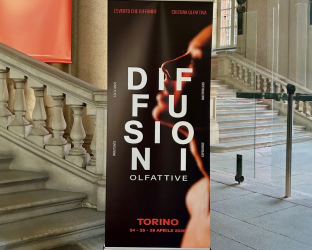

Diffusioni Olfattive panel at the entrance of Palazzo Carignano in Turin
I arrived in Turin on April 24th in the early afternoon, welcomed by one of those luminous spring days that seem staged. Piazza Carlo Alberto was flooded with sunlight, making the imposing façade of Palazzo Carignano stand out against the crystal-clear sky. Walking through the arcades, the majestic shadow of the grand staircase seemed to swallow me, offering a theatrical counterpoint to the dazzling spring light outside. Along the steps, severe busts of mid-19th-century Italian noblemen stood in silent procession, as if still guarding the political dream born within those walls.

The grand staircase of Museo del Risorgimento
And then, unexpectedly, a scent: sweet yet finely piercing. What was it? Carnation. Vaguely green, spicy, rosy. It drifted through the stairwell with a strangely reassuring familiarity, carrying me back to childhood afternoons in my grandparents’ courtyard, where that same smell rose from my grandmother’s large clay planters, spilling over with cascading carnations, their trailing stems unfolding into celadon ribbons flecked with pink ruffles—moments of belonging. It instantly swept away the anxiety I felt before my talk.
From April 24th to 26th, Turin hosted the first edition of Diffusioni Olfattive, a three-day event dedicated to perfume through talks, round tables, and olfactory installations spanning history, science, and creativity. What made the atmosphere refreshing was how far the event stood from the usual commercial dynamics of perfumery, even though sponsors and industry partners made it possible—a rare but necessary form of giving something back to the public through culture.

Aula della Camera Italiana ceiling
After making the last adjustments to my presentation, I had the honor of opening the event with Il Profumo di una Nazione in Costruzione (The Scent of a Nation under Construction). Speaking in the recently restored Aula della Camera Italiana, under the watchful eye of mighty telamones, with jaw-dropping ceiling frescoes soaring 23 meters above us—was deeply emotional. In the very room where the first Italian Parliament gathered, I revived the genius loci of the place, tracing another national narrative: Italy’s construction through citrus from the South, iris from Tuscany, violets from the North, along with other minor aromatic crops, their economic impact, craftsmanship, commerce, and perfume houses such as Acqua di Felsina, Bertelli, and Angelo Migone & C., which gained international recognition by the early 20th century.

Ermano talking about Calabrian bergamot and ancient extraction techniques at Diffusioni Olfattive/ personal archive
Being at the Museo del Risorgimento, I was pleased that my lecture inspired several people in the audience to visit the museum afterward. One passage of my talk focused on the cession of the County of Nice to France in 1860, a crucial territory for aromatic cultivation whose loss deeply affected the perfumery economy of the newly established Kingdom of Italy. Many families from Piedmont, long accustomed to working in flower crops, found themselves across a newly drawn border and gradually settled in France as prospects in the Kingdom grew uncertain. Later, Jean-Claude Ellena told me his own Italian ancestors had followed that same path. “My grandmother was born in the jasmine fields,” he said. “I am the sixth generation in perfumery.”
The first afternoon continued with Dr. Luca Raimondo’s Olfatto e Profumi, tra scienza e alchimia (Olfaction and perfumes, between science and alchemy), a lucid bridge between medical science and the elusive language of smell. As head of the Olfactory and Taste Disorders Center at Humanitas Gradenigo Hospital in Turin, Raimondo reminded us that smell and taste—the Cinderellas of the five senses—are protagonists of daily life. A dish, a glass of wine, a fine perfume, a spring walk in the hills: without them, the world would resemble a silent black-and-white film.
His talk clarified the anatomical and physiological differences between smell and taste, often confused under the generic notion of “flavor.” He also debunked persistent myths, including the outdated map of the tongue divided into fixed taste regions (spoiler: every region of the tongue can perceive all tastes). Most surprising was his mention of lesser-known perceptions, such as oleogustus—the fatty sensation produced by the breakdown of fatty acids in the mouth—and even the so-called taste of water, whose neural perception was recently identified accidentally in laboratory experiments. From now on, perhaps, no one should laugh at those who struggle to drink water because they simply dislike its taste.

Luca Maffei, Giuseppe Imprezzabile and Roberto Drago discussing the current state of Art in perfumery at Diffusioni Olfattive
The day closed with a round table featuring Luca Maffei, Giuseppe Imprezzabile and Roberto Drago on the current state of Art in perfumery, a lively exchange on creation, artistic identity, market awareness, and the fragile balance between independence and industry. Its format was playful: keywords were randomly drawn from a bag. I’ll let you imagine how words such as “creation,” “honesty,” and “market” immediately sharpened the discussion, revealing perspectives that often converged, yet remained shaped by their respective roles: a perfumer creating for many brands, a creative director and distributor, and an independent perfumer working for his own eponymous house.

left to right: Priscillia Pamart, Marie Urban and Osmothèque director Anne-Cécile Pouant with Roberto Drago founder of Diffusioni Olfattive, founder and Creative Director of Laboratorio Olfattivo and Maison Tahité and Kaon Distribution
Saturday opened under the aegis of the Osmothèque of Versailles with Viaggio nella storia del profumo (Journey through the history of perfume). Anne-Cécile Pouant, director of the Conservatoire International des Parfums, and perfumer Marie Urban guided the audience through a selection from the Osmothèque vault—now preserving more than 6,000 references—ranging from the Roman Empire’s Regale Unguentum to the glamorous post-war perfumes of the New Look dressmakers. As Ambassador for the Osmothèque in Italy, I also had the privilege of helping out the Versailles team throughout the three days, presenting the institution’s mission at the booth and letting visitors discover treasures brought to Turin in their travelling case, accompanied by anecdotes and glimpses of historical context. In such a setting, the Osmothèque’s mission felt especially meaningful: preserving perfume as living memory, and as a medium capable of reflecting society as vividly as music, fashion, or art.

Massimiliano Genot playing the intense music program of Accordi d’Essenze
Massimiliano Genot then shifted the register with Accordi d’essenze. Il pianoforte racconta (Accords of essences. The piano tales), where accords and rhythm allowed music and perfume to speak to one another. In dialogue with Roberto Drago, his presence as pianist and composer brought an unexpected poetic texture to the program: the idea that a perfume, much like a musical phrase, exists in time, unfolding through tension, silence, and return. More than a talk, it unfolded through five musical scenes, from the refined ambiance of Giovanni Anfossi to the vertiginous elevations of Scriabin, passing through Debussy’s ecstatic dissonances, each accompanied by Pre-Raphaelite and Impressionist paintings and fragrance compositions created ad hoc by Atelier Fragranze Milano. One striking pairing was the glowing aldehydic aloofness of the final olibanum-themed olfactory impression, wafting through the air in resonance with Scriabin’s music.

Lucien Ferrero talking about blackcurrant in perfumery
In the afternoon, Maître Parfumeur Lucien Ferrero revisited The ’70s. The Fashion of Blackcurrant. Surprisingly, what became the most innovative natural raw material of the decade—first introduced by Jean-Paul Guerlain with the pivotal fruity-green rose Chamade (1969), had actually begun a decade earlier with the intuition of the visionary Monique and Christian Rémy, who settled in Grasse in 1965. Monsieur Ferrero, who knew them both well, recalled Monique’s flair for excellence in perfecting extraction techniques, while Christian possessed an extraordinary instinct as a source of essences, along with a rare warmth that made people instinctively trust him. It was he, in fact, who convinced Burgundy winemakers to grow blackcurrant alongside their vines, so that during the winter resting season they could turn those dark buds into a side income.
Tangy and juicy like the berries, vegetal and minty like the buds, and oddly sulphurous in the way of passion fruit or mango, blackcurrant bud absolute blew new life into green and floral notes in the seventies. Even today, after the transition from hand-picking to machine harvesting, blackcurrant bud absolute remains highly prized—and priced—for the unique vibrancy it lends to hesperidic, fruity, and aromatic accords, remaining among the leading productions of Floral Concept, the company founded by Frédérique Rémy and her husband Jean-Pierre Mignatelli.
But how did blackcurrant buds become so widely popular during the decade? “C’est la faute à Ferrero,” one might say, paraphrasing Victor Hugo. A young Lucien Ferrero was then working in Givaudan’s research team dedicated to discovering new raw materials, and it was he who first smelled the sulphurous absolute and became so captivated that he brought it to the company’s attention. In less than a decade, it introduced a radically new note into perfumery, appearing in groundbreaking fragrances such as Paco Rabanne pour Homme (Jean Martel, 1973), Amazone (Maurice Maurin, 1974), Azzaro pour Femme (Lucien Ferrero and Maurice Tibhoud, 1975), First (Jean-Claude Ellena, 1976), and Mûre et Musc (Jean Laporte with Pierre and Jean-Claude Ellena, 1978). Since then, this chameleon-like raw material has crossed paths with countless perfumers and styles, becoming a true staple in the perfumer’s palette.
Then came Giuseppe Imprezzabile— better known as Meo Fusciuni—with La poetica olfattiva (The olfactory poetry), a deeply personal reading of the poems and literary voices that shaped his creative path and gradually traced the intimate geography behind his fragrances. Each word, carefully chosen by poets much like raw materials selected by a perfumer, floats through the air, while the sentence itself—through its logical arc, grammar, resonances, and dissonances—develops like accords within a fragrance formula.
Luca Maffei closed the day with Il profumo del futuro, addressing the future of perfumery from the perspective of a creator and entrepreneur, where innovation in materials and tools must still preserve the mysterious human spark that makes a fragrance more than a product.

The historical flacons exhibition at the Diffusioni Olfattive venue
Beyond the conferences, the event also offered several experiential paths. An exhibition of historical flacons traced perfume culture from the late 18th century to the post–World War II period, revealing the evolution of design shifting from dreamy opulence to daring assertion, from artisanal craftsmanship to industrial production, from tradition to experimentation. Atelier Fragranze Milano proposed a playful exploration around the poetry of everyday life: dark apothecary jars labeled with familiar smells such as bread, talcum powder, and Marseille soap invited visitors to wander from one accord to another, like opening the drawers of a domestic cabinet and rediscovering everyday memories.

Atelier Fragranze Milano library of familiar smells
CPL Aromas explored gourmand pleasures, including a date accord balancing sweetness and sophistication. There was also an olfactory path inspired by the figures who once inhabited Palazzo Carignano, translating historical personalities into fragrant impressions. Among them, the Countess of Castiglione emerged through heady white florals dusted with chalky face powders and a trail of sweet balms vanishing like an apparition.

Jean-Claude Ellena with Roberto Drago
Sunday morning belonged to Jean-Claude Ellena. His talk, L’AI e il profumo tra fede e ragione (AI and Perfume, Between Faith and Reason), was one of the most compelling moments of the event. “AI will never create a good perfume because it does not know how to forget,” he argued. For Ellena, creation is linked to oblivion: forgetting forces the artist to seek new paths, drawing upon technique. A machine can archive, combine, and suggest, but it cannot doubt, hesitate, or choose with a soul.
Moving from chemistry to painting, from synthetic materials to Pascal’s distinction between esprit de finesse and esprit de géométrie, Ellena showed how research can enlarge the creative field, much as chemistry once expanded the painter’s palette. Yet only the human mind, in his view, can truly make use of doubt, questioning its own intuitions. AI, for him, is a freeze-frame of the present rather than the future. When asked whether artificial intelligence could help perfumers think outside habitual creative patterns, he quipped: “No, because I already know the other paths AI can suggest. And I am faster than ChatGPT.”
Later, Roberto Drago, chef Matteo Baronetto and Luca Maffei explored the porous border between taste and smell in Tra gusto e olfatto. Profumo di cibo. The dialogue between cuisine and perfumery became tangible through materials such as Sulfurol, a sulfur-containing molecule used in both. With its umami facets: salty popcorn, overcooked milk, broth, bouillon cube, even cured meat, it creates an addictive, mouthwatering effect. Useful for milk and sandalwood accords, Sulfurol can also enhance the savoriness of cooked ham, as Luca Maffei pointed out, revealing how certain raw materials move seamlessly between fragrance and flavor, triggering immediate sensorial gratification in both realms.
After lunch, Roberto Drago closed the program with Comunicare il profumo, a witty, thought-provoking reflection on the almost impossible task of communicating perfume itself—not the bottle, not the campaign, not the celebrity attached to it, but the invisible olfactory architecture of the liquid. Moving from mid-19th century sketches to the elaborate Belle Époque illustrations, from Avedon’s black-and-white to today’s AI-generated imagery and viral influencers. Drago highlighted a revealing paradox in advertising. In most luxury industries, the product remains the protagonist: a car advertisement proudly displays design, engineering, optional features, performance, sometimes even the price. Perfume, instead, almost always escapes direct representation. Its shape is invisible and its impact deeply subjective. And so, perfume communication often ends up overcoming the difficulty of describing scent simply by avoiding it altogether, shifting the focus toward glamorous settings, beautiful faces, memorable slogans, and seductive music telling us almost everything—except how the fragrance smells. Yet the talk also reminded us that some creators, writers, brands, and educators still insist on placing perfume back at the center of discourse. Because if scent disappears from the conversation, perfumery risks becoming little more than beautiful imagery detached from olfactory substance. Judging from the amused reactions in the audience, everyone recognized at least a fragment of truth in that irony. Perhaps this is also one of the reasons Diffusioni Olfattive exists.
And all along, that carnation persisted in my mind. I had almost convinced myself it was a phantasma, memory and emotion conspiring to fool the senses. Only later did I discover its source: Roberto Drago had worn it on the first day, filling the staircase with its trail. It was In Carnation, the latest Laboratorio Olfattivo fragrance created with Jean-Claude Ellena: a green, spicy, solar and voluptuous carnation, overflowing with Damask rose and natural carnation essence, resting on musks that ruffle its petals into a soft pompon.

Saying goodbye to Turin. Looking forward to next year with Diffusioni Olfattive
In the end, that carnation will remain forever tied to my memory of Diffusioni Olfattive itself: the emotion of my talk, the atmosphere of the place, and above all the remarkable people I had the chance to meet and listen to. If a good day can be judged from its morning, then Turin’s newest olfactory gathering already seems to have found its voice. Better keep Turin on your calendar for next spring.
Ermano Picco-Editor
all photos by Ermano©
Follow us on Instagram @cafleurebonofficial @magnifiscent @diffusioniolfattive @wine_food_smell_luke @lucamaffei @robertodrago1 @meofusciuni_parfums @osmothequeparf @massimiliano_genot @anthologieparfums @atelierfragranzemilano @cpl_aromas @baronettomatteo @laboratorioolfattivo
This is our Privacy Policy
Like our Facebook page: Çafleurebon and use our blog feed for new updates and articles.
Trending Products


YouKD Summer Long Kaftan Bohemian Beach Kimono Swimsuit Cover Up Plus Size Dress for Women