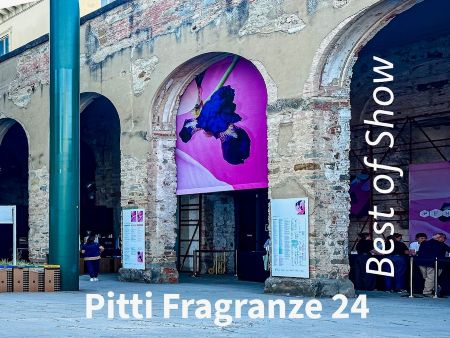

Pitti Fragranze 2026 entrance at Leopolda Station
For almost a quarter of a century, every September Florence has briefly become the main coordinate on the international perfume map. This year, however, walking into the Stazione Leopolda for the twenty-fourth edition of Pitti Fragranze, held from September 11th to 13th, I had the distinct impression that the map itself had stretched wider.
Several exhibitors I spoke with noticed the same thing: fewer familiar faces from the Italian retail scene, perhaps, but noticeably more international buyers, journalists and content creators moving through the aisles, overlapping languages, gestures and dressing styles under the iron vaults of the Leopolda.
The official theme of Pitti Fragranze 2026 was CURA — care as protection, research, intuition and attention towards ourselves, others and the world around us. A dusty-indigo iris corolla, gently swaying above the main arcade, became its visual emblem. It was an apt image for a fair that has built its identity on selection over the years, remaining faithful to the same historic venue and therefore necessarily limiting the number of exhibitors. The form of cura I noticed most, however, was precisely this commitment to scouting and keeping the bar high, especially with a steady international attention towards Florence.

On paper, Pitti Fragranze 2026 was the biggest edition yet: over 290 brands, about 75% from abroad, over 2,200 visitors, almost 600 international retailers from more than 50 countries and roughly 460 journalists and media professionals. The exhibitors reflected the same geography. Europe remained strongly represented, but brands also arrived from China and Hong Kong, South Korea, Japan, Taiwan, Thailand, the United States, Australia, the Middle East and Africa.
Timing likely affected the makeup of the crowd. With Esxence exceptionally moved from March to June and TFWA Cannes opening barely two weeks after Pitti, the 2026 calendar squeezed three major industry appointments into a very narrow window, leaving Fragranze caught between two giants. For Italian retailers, already navigating a mature domestic niche market and more cautious consumer spending, attending every fair may simply have become harder to justify. If the Italian presence occasionally felt less visible, the rest of the world seemed more present than ever.
Nowhere was this clearer than in the growing Asian presence. China, South Korea and Japan were not only represented among visitors and buyers: independent Asian brands increasingly arrived with their own visual codes, ingredients, references and ways of telling stories.
This year Code Korea, developed with the Korea Creative Content Agency, gave Korean beauty culture an official place within the architecture of Fragranze. Alongside it, names such as Kuoca, Saranghaeyo, HB and the Japanese project of Tomoo Inaba made it clear that Asia is no longer simply visiting the European niche-perfumery conversation but actively reshaping it.
Among the hundreds of booths filling the Leopolda, these are the ones that made me stop, smell twice, ask another question — and carry something away with me after leaving Florence.

Tomoo Inaba with his new brand at Pitti Fragranze 2026
Tomoo Inaba
If one discovery summed up what felt genuinely new at Pitti Fragranze 2026, it was Tomoo Inaba: Japanese precision meeting the architecture of classical French perfumery, with the refined, poetic touch that has long distinguished his work. I had met Tomoo again in Milan last June, when he gave me a promising preview of the line. At Pitti I could finally return to it properly.
Amaterasuite is a contemporary homage to the emerald-and-gold atmosphere of Coty’s Emeraude, its name playing with Amaterasu, the Shinto sun goddess. Rather than feeling like a retro quotation, it filters a great Western classic through Japanese sensibility: aldehydes sparkle alongside fresh ginger, prickling the nose with a lively freshness before the exotic greenness of banana foliage emerges. At the heart, velvety osmanthus rests on a lavish bed of woods and amber. Then came a glimpse of what is still to come. Masquis Yorisaka, created by Tomoo with Russian perfumer of Chinese-German origins Eugene Ti, takes its name from the husband of Mitsouko in Claude Farrère’s La Bataille. Built on a fougère structure made sumptuous with jasmine and an opium accord nodding to Yves Saint Laurent’s Opium, it moves into warmer, ambery and decisively unisex territory. Its opulent, benzoin-like, almost marzipan softness curiously brought to mind Le Troisième Homme de Caron, composed by another Japanese perfumer, Akiko Kamei. Whether intentional or not, the association made the fragrance feel like part of a fascinating conversation between Japanese noses and European perfumery across generations.
That ability to move between Japanese culture and the Western canon, always with grace and curiosity, is exactly what makes Tomoo Inaba’s work so rewarding to follow.

Agarthi Scent Core founder Barbara Loddo with the new introductions at Pitti Fragranze 2026
Agarthi Scent Core – Electric Sparks & Electric Flow
After digging deep into the mysteries of terrestrial magnetism last year with two attractive oud-themed creations by Julien Rasquinet, Agarthi Scent Core turned to electricity.
Electric Sparks, by Véronique Nyberg, and Electric Flow, by Violaine Collas, both revolve around an intensely juicy guava accord, vibrant and almost electrifying in itself, its strange sweetness hovering somewhere between ripe tomato and peach, sharpened by the tart, faintly sulphurous bite redolent of passion fruit.
From this shared charge, the two fragrances grow in different directions. Electric Sparks feels sharper and more vertical: Timur pepper adds a tingling spicy vibration, while cool metallic aldehydes evoke the charged air before a storm. Woods then give the composition the impression of a sudden discharge, bright and crackling.
Electric Flow, by contrast, lets the current gush deeper underneath. The guava is enriched by pineapple and coconut water lending a pina colada sweetness. A solid ambery backbone provides an enveloping, long-lasting trail, with the almost iodine-like breath of ambergris meeting a richly faceted myrrh, flickering between aldehydic brightness, fruitiness and a suave, almost liqueur-like sweetness.
Where Sparks flashes, Flow hums — two expressions of the electricity running through nature, from lightning in the sky to the invisible microcurrents linking soil, tree roots, living organisms and perhaps even emotion.

Meo Fusciuni booth with the Amara Vita “unfriend” image at Pitti Fragranze 2026
Hunger Games: Gourmand grows up
If there was one category impossible to avoid at Fragranze, it was gourmand. Following the success of hits like Margiela Matcha Meditation and Le Labo Thé Matcha 26, matcha latte alone seemed to have multiplied across collections with the enthusiasm of a particularly successful franchise. Yet some of the most interesting discoveries suggested that gourmand is now becoming less about reproducing dessert and more about using taste, and texture to explore a wider food menu as olfactory material.
Meo Fusciuni Amara Vita marked his first openly gourmand excursion, though predictably in a language far removed from confectionery sweetness. Dark chocolate turns powdery, spicy and balsamic, paired with raspberry compote blending in animalics into something halfway between warm Black Forest cake and cacao beans cracking under the teeth. I could not resist spraying it on my arm, where it settled into a mellow powderiness, with a generous dose of benzoin giving the base a rich resinous warmth and impressive staying power.
The story behind it is one of first love and abandonment, and the accompanying visual immediately betrayed Meo’s generation. A photograph of a couple has undergone a distinctly analogue version of the “unfriend”: his face violently scribbled out, hers physically cut away, leaving a hole in the picture.
There was a time when unfriending someone required scissors, ink and commitment. It was total, irreversible and, perhaps for that very reason, more carefully considered. Amara Vita carries something of that same bittersweet aftertaste.

HBRN Oyatt Redbean at Pitti Fragranze 2026
At Korean house HBRN, a remarkably refined presentation already suggested a dialogue between tradition and modernity: ceramic caps vaguely recalling bamboo, muted almost-non-colors and a tactile restraint far removed from the louder codes of contemporary gourmand.
Among four recent fragrances created with Cécile Matton, Oyatt Redbean was one of my greatest surprises of the fair. Elemi gives the opening a peppery, orange-rind freshness before the fragrance sinks into the soft, powdery sweetness of red-bean paste, dense and slightly aromatic.
Rather than simply smelling gourmand, Oyatt Redbean takes one of the most iconic fillings of Asian pastry, subdued in sweetness to a Western palate, and turns it above all into texture: cushioned, velvety, sweet and savory, almost floury. It feels like a true neo-gourmand, built around an edible note still unusual in Western perfumery.
Sprayed on my wrist, its vegetal, raspberry-tinged powder immediately brought me back to the poetic atmosphere of Naomi Kawase’s Sweet Bean: that same sense of intimacy, tenderness and resilience. One of the most original gourmand ideas I have encountered in recent years.

Antonio Alessandria Parfums booth showcasing Aporia
Antonio Alessandria takes gourmand into a more pensive territory.
The name of his latest introduction, Antonio Alessandria Parfums Aporia, refers to the philosophical impasse in which two opposing truths coexist without offering any clear way out. Antonio translates that suspended state into the remains of a solitary evening spent looking for comfort: tobacco smoked, alcohol drunk, something sweet slowly nibbled while unresolved thoughts keep circling. Evoking the ancient Nepenthe, the mythical drug Helen of Troy poured into wine to soothe the pain of memory, that fleeting idea of consolation becomes the olfactory starting point. Sweetness leads at first: sweet orange lends freshness to toasted hazelnut, plum and sultanas, brightened by the rosé-wine facet of davana and the wild-strawberry nuance of geranium. Everything feels lightly drizzled with white honey.
Then the more grown-up notes emerge: blonde tobacco swirls out of the honeyed facets, bringing dryness and depth, while immortelle adds a faint golden glimmer of turmeric over the milky hues of tonka bean, backed by warm musks.
On skin, what struck me most was its almost edible tobacco: nutty, honeyed, dense enough that one feels more tempted to chew it than smoke it. Sweet and bitter at once, Aporia is less a dessert than a temporary anesthetic — the comforting illusion that, for a little while, a world increasingly difficult to make sense of can be set aside.

Kuoca displaying their fragrant menu at Pitti Fragranze 2926
Korea at the table
The most literal expression of the food obsession came from Korean brand Kuoca, whose stand looked like the table setting of a Michelin-starred restaurant: flacons shaped like ice-cream coups, blotters cut as knives and forks, and fragrances listed on a menu as if they were courses.
The brand makes the metaphor explicit: perfume arrives “as a course does,” one recipe at a time, to be savored from first note to last. The collection includes six eaux de parfum and one extrait de parfum.
The fruity-gourmand vein runs throughout, inevitably including yet another matcha latte — by now almost a compulsory menu item for brands courting gourmand lovers. The extrait offered a less edible counterpoint: a hinoki-like woody composition brushed with elegant touches of raspberry and iris.
The fragrances are polished and pleasant, though most remain within a similar fruity-creamy-sugary register. What Kuoca will surely be remembered for at Pitti Fragranze 2026e, however, is its impeccable mise en scène: playfully chic and remarkably coherent.
Another Korean scent that caught my attention was the new Saranghaeyo 99. M OF_U, inspired by the traditional red ink pad used in Korea for personal seals. By custom, grandparents may give a newborn a personalized stamp that will later mark some of life’s key passages — school admissions, contracts, marriage, property and official documents. The fragrance takes its cue from the scented red inju ink pad itself, while the name M OF_U, short for memorandum of understanding, plays on the idea that a single signature can sometimes alter the course of a life.
On skin, I found it intriguingly metallic and herbal with artemisia, and slightly spicy with harissa-like hints in its aromatic heat. A solid pillar of hinoki runs through the composition, its incense-like dryness softened by rose and jasmine, leaving a camphoraceous, almost medicinal yet strangely charming trail. What makes M OF_U memorable is how deeply it engages with its cultural reference. To my nose, it feels like the brand’s first real dive into Korean tradition — the kind of gesture that can give substance to the “real” K-wave, beyond provenance and cool aesthetics alone. This is the scent of a gesture meant to be worn — and to leave a mark.
Flowers, but make them alive
Neo-gourmand may have become one of the firmest baselines of the niche market, but the classics are going nowhere. If anything, they keep proving how much room there still is to play with the golden standards of the perfumer’s palette, breathing new life into them. Flowers remain at the top of that list, with their ability to shift shape and color like a chameleon: under skilled hands, petals can turn juicy and sappy, be dusted with spices, bend towards moist earth, or pick up the sensual traces of nocturnal animalics.

Andy Tauer Geranium Absolue at Pitti Fragranze 2026
I have followed Andy Tauer since his early days, long enough to witness his growth as a perfumer and the natural shifts of an independent creative path. With Geranium Absolue, part of his Absolue line, I sensed a rediscovered freedom: beautiful materials shining at the core, a compositional ease where everything falls effortlessly into place, and somehow a smile I had not felt in his work for some time. Tauer told me he had tried for years to build a perfume around geranium, only to find the material slipping too easily into familiar territories: too rosy, too green, too clean, too overthought. The breakthrough came when he looked back to where modern perfumery started it all: fougère. Fresh herbs, vanillin and coumarin — a juxtaposition that, backed by ambery materials, also echoes some of his best-known creations. The result sits, as Tauer himself puts it, “somewhere between the leaf and the flower.” Geranium unfolds rosy, crisp, aromatic and softly powdery, with flashes of wild strawberry and that wonderful truffle-like earthiness found in top-quality Bourbon geranium. Bergamot and lemon bring light, while coriander, rosemary and a dash of lavender give the greenery a vivid, three-dimensional crispness. Vanillin and coumarin add a warm dusting without turning edible — more hay and talcum powder on clean skin than dessert — while labdanum, oakmoss, a scoop of patchouli and vetiver bring the velvety feel of leaves, a breath of damp soil and just enough mystery underneath, letting the geranium sing. There is a classical innuendo in Geranium Absolue, but nothing nostalgic about it: simply pitch-perfect beauty. Fresh, joyful, vibrant and unmistakably Tauer. Welcome back, Andy.

Recensione Negativa playful labeling for Barbarosa at Pitti Fragranze 2026
Barbarosa — literally “pink beard” in Italian — is the latest creation by Cristian Cavagna to join the Huile Absolue line of Recensione Negativa, pushing the rose-geranium dialogue into a brighter, juicier, decidedly pop register. Rhubarb slides in with its red, bittersweet, acidulated stems, giving the fragrance a crisp, juicy backbone, softened by the raspberry-like facets of rose and the lychee nuances of geranium. The result is colorful, fun, unisex and perfectly in tune with the irreverent spirit of the brand.
And having made beard and moustache something of a personal trademark over the years, how could I possibly resist a perfume oil absolute called BARBArosa?

Jouissance Faire la Noce at Pitti Fragranze 2026
At the Jouissance booth, I finally had the pleasure of meeting founder and creative director Cherry Cheng, whose magnetic gentleness made the encounter as memorable as the sophistication of her perfumes.
Her latest introduction, Faire la Noce, takes its name from the French expression for partying to excess — drinking, dancing, spending and generally slipping loose from the rules. The inspiration comes from Jean Rhys’ Paris years and, in particular, from Quartet, with its charged atmosphere of desire, dependence and transgression.
Absinthe opens with a bitter, almost cocktail-like spark, before an elegant bouquet of crisp roses, violets and white flowers, led by narcissus, brings its green and faintly barnyard shadow. Sweet tobacco smoke swirls through the composition, giving the bouquet a darker, earthy, more nocturnal trail without taking over.
Still perfectly in line with the retro-chic allure of Jouissance’s earlier compositions, Faire la Noce brings more joie de vivre, less brooding nostalgia, and a much-needed breath of youth to the collection.
I just quickly stopped by at AVII to say hello to founder Artur Grigoryan, once again at the booth with his mother. While chatting about the fair, he took the chance to thank me for a photograph I had taken of them at Esxence. Actually, the credit was mostly hers: she has one of those wonderfully expressive, photogenic faces, almost straight out of a Kiarostami film, so getting a good picture is hardly difficult. Artur laughed and replied that she is just like him: neither of them can hide what they feel, so it inevitably shows on their faces.
He then happily gave me a sneak peek of the next creation by Céline Guivarch, due in spring and still unnamed: a refined, velvety red rose with honeyed accents — a graceful nod to Artur’s Armenian roots — resting on a seductive, softly chypre base.

Michele Marin Essenza E13 Voile Blanc at Pitti Fragranze 2026
Sacred, pure… but not too pure
Michele Marin’s latest creation was one of the most cinematic scents I smelled at Fragranze.
The inspiration behind the extrait de parfum E13 Voile Blanc comes from Florence’s Murate, the women who chose radical enclosure in tiny cells built along the Arno before later giving their name to the monastery in Via Ghibellina. Michele drew not only on the religious imagery, but on something more physical: damp walls, confined rooms, old wood, the memory of those first shelters suspended over the river. Perhaps inevitably, given Michele’s fifteen years as an assistant director in cinema, theatre and opera, E13 Voile Blanc also has something distinctly scenographic about it. As I smelled it, I couldn’t help picturing white veils, convent walls, and the suppressed longing of Zeffirelli’s Storia di una capinera (Sparrow).
Elemi and olibanum open the composition with a peppery, aldehydic brightness, sharpened by the austere aromatic verticality of cypress. Iris then spreads over everything like a white veil, immaculate and almost chalky, while ghosts of rose and the watery vegetal greenness of galbanum bring the damp breath of a hidden garden. The chiaroscuro comes from cedar, patchouli and a whisper of birch tar, evoking cold ancient walls and old wooden beams, barely warmed by amber and white musks. That silent gloom suggests meditation and sacrifice — the renunciation of the body that, paradoxically, seems only to make its needs more vivid.
Then comes the faintest tremor of civet beneath all that whiteness. Among white walls, pure thoughts… but not too pure.

Laboratorio Olfattivo Bagage à main at Pitti Fragranze 2026
Objects carrying memory
Laboratorio Olfattivo Bagage à Main, created by Pierre-Constantin Guéros (his young perfumer essay here) , turns a very personal memory into scent: the caramel-colored leather travelling bag his father made and gave him when he was young. The reference runs particularly deep for Guéros, who comes from generations of tanners and leather craftsmen.
As a young perfumer, he first sketched a leather accord; twenty-five years later, Bagage à Main finally gave him the chance to bring it fully to life. Rather than offering yet another modern suede-like take on leather, the fragrance builds its illusion through an intriguing ambery, aromatic warmth with a distinctly Mediterranean feel, leaning towards the resinous facets of cistus labdanum. Nutmeg adds an almost medicinal, opaque grain, while vetiver, patchouli and Peru balsam suggest the patina of a well-travelled bag, handled and carried around the world for years.
A Lautier 1795 co-distillate of tonka bean and Tabanone adds depth with a plummy, blond-tobacco creaminess, lending supple flesh to the bag, while Ambronova brings smoothness and remarkable radiance to the composition. The caramel shade of the packaging echoes the color of the original bag.

Teatime at State of Mind at Pitti Fragranze 2026
Passing by State of Mind to say hello to founder Catherine Laskine-Balandina, I accepted her usual invitation to sit down for tea and a chat. While talking with another guest at the stand, the conversation drifted towards raw materials and, eventually, clary sage. At the word sage, Catherine immediately reached for French Gallantry and sprayed it for us. Created in 2019 by Karine Dubreuil-Sereni, it suddenly revealed all the aromatic elegance of the note.
Clary sage absolute is one of those wonderfully complex materials that seems to contain several hues at once: aromatic and herbal, yet also camphoraceous and incense-like, with a peculiar ambery radiance somewhere between cathedral air and ambergris. Then come unexpected whispers of ripe pineapple and a soft heliotrope-like floralcy. At high dilution, it can even suggest herbal tea, and I guess that’s why Catherine wanted it as one of the key materials of French Gallantry. Here Dubreuil-Sereni sets it within an entire herb garden of tomato, basil, thyme, bay leaf and oregano, while Kenyan black tea brings a dry, tannic dimension. Heliotrope, Russian leather and amber gradually deepen the cool aromatic brew into something warmer and more sensual. As for various fragrances in the line, the idea extends beyond perfume: State of Mind created a matching French Gallantry tea, based on Kenyan black tea and echoing the fragrance through the same aromatic herbs. At a fair inevitably obsessed with new launches, it was good to rediscover a seven-year-old fragrance with fresh eyes — or rather, through a newly attentive nose.

Sasva founder Sriman Subramanian
I also stopped by Sasva Parfums to meet its founder, Sriman Subramanian, who welcomed me with infectious enthusiasm and talked me through his vision of contemporary Indian perfumery: young, colorful and playful, but also unapologetically glamorous and sparkling. It fits a house conceived around a modern, cosmopolitan India, while keeping tradition in the background rather than at the center. He then took me through the collection, and somewhat unexpectedly my favorite was Sapna, the fruitiest and booziest fragrance in the Le Notti di Goa collection. Created by Philippine Courtière, it brings together mango, plum and coconut water with boozy notes, conjuring a thirst-quenching cocktail to start the night. Tropical, nocturnal, carefree and slightly tipsy, it has the air of a beach party in Goa as a whiff of iris-dusted jasmine lends natural elegance and the fruit finally sinks into a leathery amber bed to collapse into at dawn.
A changing vocabulary
Matcha, red-bean paste, guava, Korean influences, Shinto mythology and Japanese literature now sit naturally alongside fougère, chypre, caramel macchiato, and masterpieces like Mitsouko and Opium. The old perfume vocabulary is still alive, but new memories and references are stretching its borders.
This is why Tomoo Inaba’s creations felt so emblematic of this edition: they show how Japanese culture and the Western perfume canon can meet effortlessly, finding a remarkable point of balance.
By the end of the fair, CURA, this edition’s theme, finally seemed clear: in the attention paid to people, stories and cultures, approached with genuine curiosity that spark new forms of creativity in perfumery.

Ermano and Olivier Durbano selfie just for Michelyn.
This year Olivier Durbano didn’t introduce any new creation (Michelyn was the first to announce this here) yet he was pretty satisfied with the people stopping by his booth, and admitted to have finished all the blotters earlier than the previous years.
See you next year Firenze!
Ermano Picco, Editor
All photos Ermano©
Follow us on Instagram: @cafleurebonofficial @magnifiscent @pittifragranze @tomoo_inaba @tomooinaba_profice_ @gakidomo @agarthi_scentcore @meofusciuni_parfums @hbrn.kr @antonio_alessandria_parfums @kuoca.official @srhy_eurasia @andy_tauer @recensione_negativa @jouissanceparfums @aviiperfumes @michelemarinessenza @laboratorioolfattivo @stateofmind.fr @sasvaparfums @olivierdurbano
This is our Privacy Policy
Trending Products


YouKD Summer Long Kaftan Bohemian Beach Kimono Swimsuit Cover Up Plus Size Dress for Women