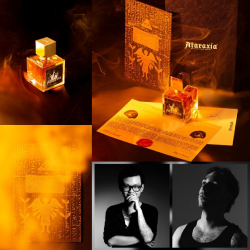

Ataraxia Perfumery Deity, image via the brand
A little bit of context first. Ataraxia (from Greek a– “without” + taraxis “disturbance”) refers to a state of serene tranquility, free from any mental turmoil, anxiety, or emotional perturbation.
Ataraxia was said to be the preferred mental state of a soldier before battle – but, looking around, I think our philosophical journeys have made most of us more WORR-iers than WARR-iors. And before life’s great bundle of never-ending, ever-surprising anxieties, my own path to something resembling ataraxia has always run through music. In (way too) early childhood, I was taken (far too often) to philharmonic concerts, where I got spectacularly bored for (seemingly infinite) hours. Then, at some point, my mind found a workaround: I began using them as self-regulating-stoic therapy sessions, think a mental version of a defragmentation protocol (getting flashes of ancient Norton SpeedDisk, with its satisfying color-coded blocks rearranging themselves into order). I would process everything between concerts with live music running in the background, including, memorably, a particularly unsettling documentary about the inevitable death of the Sun, information that felt extremely urgent and personal at age seven, with Dvořák’s Stabat Mater unfolding dramatically as I came to terms with our collective mortality. Unfortunately (and fortunately), as time passed, I began enjoying classical music so much that I became fully present in it, and lost access to my own ataraxia-induced background processing. The effect had consumed the cure.

Collage with images from Heilung concerts, fairuse
To my surprise, I was able to reach this variety of outside-induced-inner-peace, much, much later, and from a completely unexpected direction. The effect was so powerful I turned it into a full-fledged pilgrimage, following the band on tour as the end result, after each concert, every single time, was the most quiet my mind had ever been. A peace that lasted for days, weeks, even months after. Heilung means healing in German and they make the kind of music that is genuinely impossible to grasp without the full live experience – part performance art, part shamanic ritual, and all about connection to nature, each other and the primal energy within. Instruments that have been available since the Iron Age: drums, bones, spears. Ancient texts chanted in Old High German, Latin, Proto-Norse, Icelandic, costumes that are historically correct reproductions of Nordic Bronze Age clothing. The music, poetry and spoken word are mixed together into something alive, irreparable and – for me -impossible to compare to anything else as level of transferred energy and the sensation of connection that is established after each live session. Every concert ends the same way, with Hamrer Hippyer, an ancient healing chant that builds into something close to paroxysm, as the dancer-warriors return to the stage, a banner is raised, and the horned figure Kai sits high holding a torque – the divine masculine – with only one position above him occupied: the archetypal goddess. A crown made of local flowers is hurled into the crowd, marking the final offering being returned, and the healing ritual complete. I’ve yet to connect a smellscape to this particular ATARAXIA.
Well, until now, that is.

Ataraxia Perfumery Deity, image via the brand
The copy for Ataraxia Deity reads like an Ari Aster movie pitch: “You wake to a heavy sound in the night. The village gathers and follows it into the forest, where you find it: a massive body, crowned, with too many arms. The god your people have worshipped for years now lies still. It should smell of death, but it doesn’t. Instead, it is warm, sweet, and hypnotic, like honey, resin, and every offering it has ever consumed. No one speaks. As if guided by something beyond thought, you move closer and begin to eat. This is Deity.”
Until not so long ago, almost my entire heavy-rotation perfume collection revolved around the spiritual: incense-forward, meditative, and rooted in the classical, let’s call it Abrahamic -connected -tradition of sacred ingredients and ritual perfumery. Sacred smoke, resins, and holy-space associations shaped the scents I reached for most often. The pandemic years rewrote many of my assumptions, including the way I approached the art of perfumery, and I became a full-fledged convert of a category I had once (snobbishly) dismissed as shallow: the gourmand genre.
There is something about a gourmand done right: that unapologetic sensuality, the way it lives entirely in the body, all triggers that I, as a self-declared post-Epicurean neo-hedonist (working title, not printed on my cards yet), cannot really argue with. The only thing missing, for me, was the sacred layer – the sense that something older and deeper was stirring beneath the Pavlovian first response of the reptilian brain. And while there has been much recent talk of the neo-gourmands, why not put on our hyper-analytical glasses and push further into the niche within the niche, the subgenre within the subgenre and coin the term we’ve been missing: the mystical gourmand. And Ataraxia Perfumery Deity is a proud specimen of exactly that. The honey primordial version, in all its glory.

Ataraxia Perfumery Deity, image via the brand
What can be more ancestrally hedonistic yet spiritual than honey? From the promised lands of milk and honey, through the ambrosia and nectar of the gods, to the golden teardrops of the gods of the sun, flowing in the roots of Yggdrasil, honey appears again and again as a substance of abundance, blessing, and divine proximity. Across all these places, geographical and temporal, it is a shapeshifter, moving between earth and heaven, body and spirit, human labor and divine gift. Honey is one of the oldest metaphors for how the divine becomes sensorially available to human beings – as something that can be shared, remembered, and devoured. Honey as the divine made flesh. Quite literally.
Deity feels like a colour-saturated palette where every shade of gold has been layered, blended, and pushed past recognition, then drenched in honey. Rewinding the clock, we begin to separate the colours again, zooming in and sifting through the listed notes of the offering. From the dark, deep reds and crimsons emerge contours of the fruits: the mouthwatering, carnal sweetness of sticky plums, dates, apricots, and the jammy richness of overripe black cherries. These are softened by a creamy pastel register of milk, fluffy creams, and cocoa butter before a vegetal spring-like brightness cuts through with the honeycomb surrounded by pale green heads of lily of the valley, and a white floral haze. Then darkness creeps in, painted in inky resinous tones, all earthy roots and dimmed greens: vanilla, tonka, leather, benzoin, elemi, myrrh, labdanum, olibanum, and patchouli. The full altar, overflowing – as above, bearing fruit, so below, in the thick and resinous flow of its roots.
Rotating between the dark side, sensual, fetishized, sometimes feral, and honey-trapped-sweet, at other times abundantly overflowing and expansive in its solar, ripe excess, Deity comes full circle. The feeling of having consumed the offering and, in doing so, having been consumed by it. A journey that begins and ends in honey, turning the sands of time to liquid molasses pouring through an inverted hourglass. From ancient wild honey, to the kind spun by golden mechanical bees programmed to impossible perfection by a smarter artificial hive mind, to the wax of the hive itself and back again, through smoke, and roots, and gold, and the weight of everything that has ever been offered up and accepted. And somewhere at the bottom of it all, the red embers of tobacco, the reward center of the brain lighting up like a dearly missed cigar, finally lit, finally inhaled, the smoke curling upward. Per-fumum – the final offering.

Perfumer Sy Truong and Creative Director Tudor Ristea
Ataraxia Perfumery is part of the new wave of Romanian niche renaissance phenomenon that I have begun to touch on in this article. Founded by Tudor Ristea, a Gen Z creative director, musician, and influencer, the brand has recently worked with award-winning perfumer Sy Truong, and their collaboration, Deity, has recently drawn global recognition, being selected as a finalist in the prestigious Art and Olfaction Awards 2026 in the Independent category.
I always love tracing the synesthetic qualities of an artist’s work, so to get a sneak peek into the style of the composition, go visit Sy’s Instagram, where he publishes his collages, and you will instantly understand his aesthetic universe: gilded darkness twisted into something sensual, decadent, and faintly unsettling. And speaking of compatible artistic sensibilities, Tudor and Sy have more in common than you’d expect: creative industries as background – fashion design for Sy, music for Tudor, both remarkably young, both from countries with no particular tradition in the perfumery world, until now, that is (Vietnam and Romania), and both with their favourite ingredient tattooed on them: Sy with IsoButyl Quinoline, and Tudor with iris.
In a nutshell, Deity is a resinous honey tobacco scent that wears thick, round, and beautifully decadent, with a darkness coiling beneath its sweetness. For those eager to venture deeper into the mystical language of scent, beyond cathedral stone walls and onto more pagan ground, this is your offering.
Editor’s note (no spoilers): The presentation is indeed worthy of the name, featuring a sturdy magnetic collector’s box, cohesive artwork, a naturally resinous wood plaque embossed through pyrography, as well as various other knick-knacks that add depth to the lore.
Top: Honey, Japanese Plum, Cherry Jam, Chantilly Cream, Golden Berry; Heart: Condensed Milk, Tobacco Absolute, Tobacco Blonde, Cocoa Butter, Beeswax Absolute, Snowdrops; Base: Olibanum Absolute, Labdanum Absolute, Dark Cocoa, Vanilla, Tonka, Amber, Benzoin, Elemi, Myrrh, Gold, Patchouli, Dates, Nectar
Nicoleta Tomsa, Senior Editor
Disclosure: Perfume kindly gifted by the brand, as always, opinions are my own.

Ataraxia Perfumery Deity, image via the brand
Thanks to the generosity of Ataraxia Perfumery, we have a bottle of Deity for one registered reader from the EU, US and UK. You must register or your entry will not count. To be eligible, please leave a comment saying what sparks your interest based on Nicoleta’s review and where you live. Draw closes 5/13/2026
Follow us on Instagram @cafleurebonofficial@nicoleta.tomsa @ataraxia_perfumes @tudoristea @sytruong.perfumer
This is our Privacy Policy
We announce the winners only on our site and on our Facebook page, so like Çafleurebon and use our blog feed… or your dream prize will be just spilled perfume.
Like our Facebook page: Çafleurebon and use our blog feed for new updates and articles.
Trending Products


YouKD Summer Long Kaftan Bohemian Beach Kimono Swimsuit Cover Up Plus Size Dress for Women