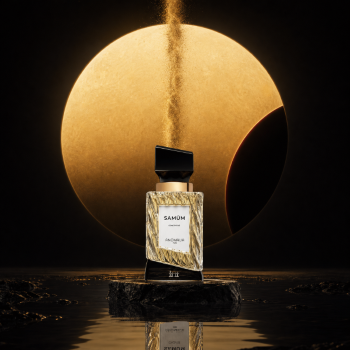

Anomalia Paris Samūm, AI collage by Nicoleta
“Samūm is a gorgeous, saffron-ignited osmanthus that I cannot wait to wear this summer, once it gets really hot.” I wrote that while reviewing Anomalia Paris Karmacoma, back in the strangely cold May we had, sending a promise forward into the approaching summer. Now, with a seemingly endless heatwave turning half of Europe into a slow-moving mirage, I have kept it. Admittedly, a leather-centred fragrance is not where I would normally gravitate during a humid European heatwave. But guess what – Samūm blew my mind. Not despite the heat, but because of it.
Then again, making apparent contradictions feel inevitable is something Elena Spirina does exceptionally well – as the woman behind Anomalia Paris has built an entire perfume house around the beauty of being “Perfectly Wrong”.

Elena Spirina of Anomalia Paris, image via the brand
Golden. Leathery. Sun-burnt. Perfectly wrong,” reads the brand’s description. That final phrase is more than Anomalia Paris wordplay. It describes exactly what happens when Samūm meets hot skin: the warmer the air becomes, the drier and more dimensional the perfume feels.
Anomalia Paris Samūm was composed for by Karine Vinchon-Spehner, the Robertet perfumer whose work reveals a remarkable instinct for taming materials with strong personalities. Her compositions often feel like a well-tempered clavier written for the unruly elements of perfumery: every material is given the right key and allowed its full resonance and among her creations are the universally loved Amouage Memoir Man, Interlude Woman, Overture Man and Boundless, but one of my favourite perfumes of all time is also hers: Francesca dell’Oro Envoutant (my article here ). Composed in 2015, Envoutant was my first encounter with Vinchon-Spehner’s interpretation of saffron and osmanthus. There, she placed them inside an intricate Art Nouveau arabesque of oud, rose, jasmine, amber and vanilla. In Anomalia Paris Samūm, Vinchon-Spehner returns to saffron and osmanthus, but moves them out of those mirrored hallways and into the open desert.

Karine Vinchon-Spehner, image via her Instagram page
The samūm takes its name from the Arabic root associated with poison. It is a strong, hot and dust-laden local wind found across the Sahara, the Levant and the Arabian Peninsula, where its temperature may exceed 54°C while relative humidity falls below ten per cent. It often arrives suddenly and can be brutally short-lived – and when air becomes hotter than the human body, wind reverses its usual function: instead of carrying heat away, it drives more heat towards the skin than perspiration can release through evaporation. Fine dust fills the eyes, nose and mouth, visibility collapses and heatstroke can follow with terrifying speed, the poison becoming the air itself. Sand rises, the horizon dissolves and the familiar world is reduced to a moving column of heat and dust – a natural phenomenon so extreme that it inevitably crossed from meteorology into mythology. In the Qur’an, the jinn are said to have been created from nār al-samūm, the “fire of the scorching wind.” Across later regional legends, the samūm acquired the character of a supernatural presence: an invisible, potentially demonic force travelling inside a red cloud, erasing roads, swallowing caravans and turning the desert into its own shifting kingdom.

Approach of the Simoom, Lithograph by Louis Haghe, 1846 wikimedia
I remember encountering the word “simoom” in Bram Stoker’s Dracula, reading it for the first time as a child and searching for it in an actual, physical dictionary, the kind with yellowed out old pages, reassuring weight and no search bar. The word acquired a dark, mythical reverberation that never quite left me, filed alongside the great mysteries that obsessed every ’90s child with access to cable television: the Bermuda Triangle, crop circles, and the apparently imminent danger of quicksand. I can almost recall the qute by heart, as Lucy watches the Count materialise: “I kept my eyes fixed on the window, but the wolf drew his head back, and a whole myriad of little specks seemed to come blowing in through the broken window, and wheeling and circling round like the pillar of dust that travellers describe when there is a simoom in the desert.”

from Tarsem Singh’s The Fall, fair use
From Stoker’s image of dust assembling itself into a body, my mind makes one of those jump cuts that perfume so often provokes and lands inside the impossible visual universe of Tarsem Singh’s The Fall. I think of that hypnotic moment when a hand touches an immense expanse of white fabric and crimson races across it, infusing the cloth like blood. Wearing Samūm feels like painting the world around me in a hot, iridescent shade of red. The composition unfurls in one continuous, cinematic movement: gold floods the canvas, cinnamon singes its edges, osmanthus opens in flashes of pale apricot light and leather gathers inside the deepest folds. Nothing about this is static; and every nuance pulls the next one into motion.

from Tarsem Singh’s The Fall, fair use
Every ingredient in Anomalia Paris Samūm seems to have passed through the element of fire, burning away until only its essential shape remains. Yet the result is the furthest thing from minimalism. It is as though Karine Vinchon-Spehner had placed a magnifying glass between the sun and her chosen materials, concentrating their heat into one burning point before allowing them to grow wildly out of proportion, larger and more vivid than reality. From the opening spray, saffron flashes against cinnamon with an almost metallic brightness. It is red, gold, electrically charged and dry, a line of crackling fire traced across the skin. A praline note waits beneath, but anyone anticipating edible sweetness should be warned: the accord behaves more like vanilla sugar exposed to extreme flame, darkened at the edges, bitter and almost smoking. The opening has the peculiar intensity of staring into sunlight for one second too long: the shapes remain, but their outlines begin to vibrate.

from Tarsem Singh’s The Fall, fair use
Anomalia Paris calls osmanthus “a flower with the warmth of apricot skin and the softness of suede,” and in Samūm, Karine Vinchon-Spehner plays beautifully with precisely that tension of the mirage. A beautifully strange, almost self-contradictory material: a tiny flower that smells less like petals than like dried apricot, peach skin, tea and soft, textured leather. Its lactonic facets create the impression of ripe, velvety fruit, while its darker undertones suggest suede, tobacco and something faintly animalic. Saffron illuminates the golden, leathery facets already concealed within the flower, while the leather accord catches them and sends them spinning in a deliciously kinetic loop of abstract sweetness, flesh, smoke, suede and heat continuously feeding one another. A ring of fire turning voluptuously on the skin. The humidity of the surrounding air amplifies the perfume’s solar radiance, while its internal construction remains resolutely dry, at times bordering on bitter and abstract. Saffron pulls the leather taut with a nervous tension, while papyrus and cedar play against the spectral sweetness of the praline, creating the sensation of an even more abstract danger slowly creeping in. There is something mineral underneath it all: the taste of hot sand caught between the teeth. The leather remains soft and supple, yet it has been bleached by light and sandblasted by wind until luxury loses its protective surface and turns back to something feral. The roses are scorched, dried out, and thorny, pressed by the heat until their red is darkened and reduced to pure pigment. Incense curls around them, suggesting ritual and smoke evaporating in open air, a necessary nod to the grand architecture of traditional Middle Eastern perfumery, but without allowing the composition to settle into nostalgia or pastiche. The pedal remains pressed firmly to the floor. Rose, smoke, leather and dust race towards a horizon that keeps moving farther away.

Anomalia Paris Samūm, AI mood image by Nicoleta
Wild and luxurious are often treated as opposites. One implies instinct, disorder and exposure; the other, control, refinement and insulation from discomfort. Samūm places them on the same burning line. Its materials are sophisticated, but the sensation is addictively feral.
Top Notes: Greek Saffron, Cinnamon, Praline; Heart Notes: Osmanthus Absolute, Rose, Incense, Leather, Base Notes: Cedarwood Fraction, Patchouli Fraction, Papyrus, Moss
Nicoleta Tomsa, Senior Editor
Disclosure: Perfume kindly gifted by the brand, as always, opinions are my own.

Anomalia Paris Samūm, image via the brand
Thanks to the generosity of Anomalia Parfums we have 70 ml for one registered reader from EU, USA or UK. You must register or your entry will not count. To be eligible, please leave a comment saying what sparks your interest based on Nicoleta’s review and where you live. Draw closes 8/25/2026
Also check out my review of Karmacoma here
Follow us on Instagram @cafleurebonofficial@nicoleta.tomsa @bloodymerry @anomaliaparis @karinevinchonperfumer
This is our Privacy Policy
We announce the winners only on our site and on our Facebook page, so like Çafleurebon and use our blog feed… or your dream prize will be just spilled perfume.
Like our Facebook page: Çafleurebon and use our blog feed for new updates and articles
Trending Products


YouKD Summer Long Kaftan Bohemian Beach Kimono Swimsuit Cover Up Plus Size Dress for Women